September is upon us. Labor Day, the start of football season, and everyone’s favorite holiday, International Talk Like A Pirate Day on Sep. 19. I’ve had that one marked on my calendar for weeks.
But this September will bring with it a new tradition for sports fans: the start of the Overtime Elite (OTE) season. With its inaugural season kicking this month, the new professional pathway for high school athletes will serve as an alternative to college basketball of the NBA G-League.
The high school basketball media conglomerate started this “league” to pay these athletes while also having no restrictions on team and individual workout time. Players will be coached by former NCAA Champion head coach Kevin Ollie and is run by former NBA executives.
A new facility is being built in Atlanta for the athletes joining and will also receive plenty of other benefits, including their college paid for in the future should they pursue a degree later in life.

Overtime Elite is hoping to sign 24 players to their rosters before starting. On Aug. 31, they announced the signing of three additional players – Malik Bowman, De’Vontes Cobbs and Kok Yat – to bring their current total up to 19, just five short of their goal. Teams within will play each other, top prep schools around the country and other international squads.
With backing from Jeff Bezos, Drake, Trae Young, Kevin Durant and others, certainly plenty believe that this will eventually turn a profit. I fall into that camp – probably not this year, but with the level of talent OTE is bringing in, NBA scouts will have to make their way to games at some point and I think the interest level from fans will rise around then too. Again, though, probably not this year.
My real concern is when will this even start? At the time of writing this, they still need to sign five more high school players, and their classes for the year have already started. There is no public schedule put together, even though they have claimed to start in September. None of their recent releases touch on this, leaving the public in the dark on when to even start getting excited about play starting.
Even with that in mind, I believe there is clearly a market for this type of business venture to be successful. While the G-League Ignite has largely been a comparison for skeptics who would disagree, I feel that the NBA’s developmental system that was already in place is not attractive for the average viewer – athletes playing that they do not know and likely think that will never make the NBA (aside from the stars on Ignite). Overtime Elite, however, is getting younger guys that still have the potential to be high-level professionals, (in theory) playing against teams the average viewer has heard of in the prep and international ranks.
In addition, unlike the G-League, OTE will take plenty of recruits away from the college ranks, as we already have seen. They have already signed top-15, five-star guys who would traditionally be one-and-done at the Division I level. However, what set their signings a part is the other players joining.
While top international players such as Izan Almansa and Alexandre Sarr have already signed, what the biggest telltale sign for me is their active recruitment in multiple three- and four-star athletes.
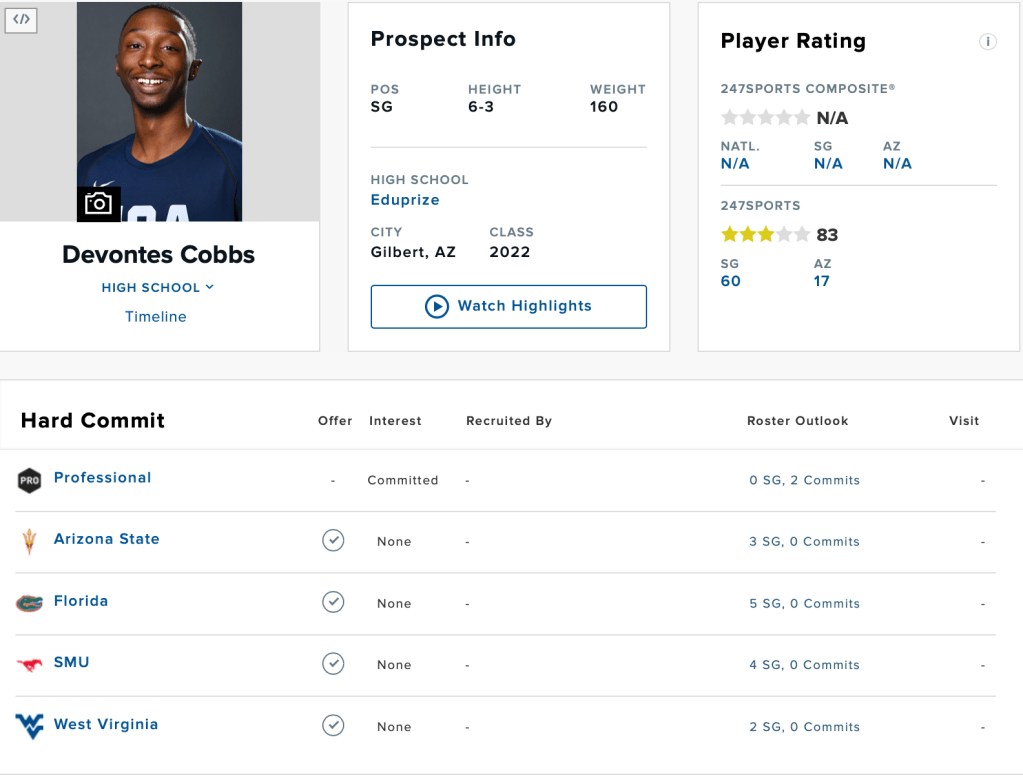
These are the kind of players that are rotational guys on high-majors and starters on mid-major teams. Cobbs committing to OTE yesterday was the biggest red flag on this for me personally – not ranked in the 247Sports Composite for the class of 2022 and ranked No. 60 at his position nationally by their own databases. Held offers from Arizona St., Florida, SMU and West Virginia.
College basketball losing this genre of player maybe is not concerning, but it surely is something to watch in the future. Now that athletes can move schools once without sitting out, schools like SMU, as an example, suffer because their best players are likely to jump up to a bigger brand. To put it bluntly, SMU will have difficulties trying to retain their own best players and recruit against a legitimate professional pathway.
The variety OTE brings in is where this could potentially change the kind of players that come into college basketball. They will bring in headliner players, top international athletes and recruits who would have been a three or four-year player somewhere.
While the collegiate hoops landscape continues to change, so does the professional outlets these guys have to make life-changing money before hopefully achieving their dreams. I think Overtime Elite, while having a rocky start, will end up becoming the top spot for high school players to go as an alternative for college basketball. I eagerly await its start later this month; I will be following and covering the “league” throughout its maiden voyage.

 Cullinane Portfolio